Where to go for Songkran Festival

on 3.18.2009

Songkran Festival 2009 6 Apr 2009 - 21 Apr 2009

Splashing blessings on everyone in sight


While the water splashing will flourish, the traditional values of Songkran are the focus of the 2009 celebrations.
Songkran is without doubt the most popular of all Thai festivals and rightly so. It marks the beginning of a new astrological year and its exact dates are determined by the old lunar calendar of Siam.

This year the festival falls from 6 to 21 April.

Nong Khai Grand Songkran Festival
Date:6-18 April 2009
Venue: Wat Pho Chai and acrosss Nong Khai province

You will see beautiful processions to sprinkle ater onto the sacred Luang Pho Phra Sai at Wat Pho Chai. Join in the water splashing to celebrate the new Year. Watch Thai traditional sports. Visit our beloved elederly people and ask for their blessing. There's also cultureal activities and all kinds of entertainment offer during the festival.


Dok Khun Siang Khaen Songkan Festival
Date:8-15 April 2009
Venue: Bueng Kaen Nakhon and Khao Niao Road

Experience the beauty of dok khun flowers in full yellow bloom through this northeast province. Enjoy the water splashing of Songkran I-San style in the unique Sticky Rice Road (Thanon Khao Niao), as well as demostrations and a contest for the most delectable local cuisine in the grand city of Khon Kean. Also see beauty ox-cart processions decorated with beautiful flowers and a beauty pageant.

Bangkok Songkran Festival
Date:11-15 April 2009
Venue: Ratchadamnoen Avenue, Khao San Road, Phra Athit Road, Bang Lamphu, Santi
Chai Park, Sanam Luang and temples in Rattanakosin Island.

Songkran embodies traditional Thai cultures values. The underlying significance of Songkran is the process of cleansing and purification starting the New Year afresh with all that is good and pure.


Hat Yai Midnight Songkran Festival
Date:12-15 April 2009
Venue: Niphat Uthit 1 Road and Sanehanuson Road, Hat Yai, Songkhla

Come and splash water to celebrate Songkran and see a pageant of beauty queens, Witness a breath taking procession. Enjoy the fire show, culture performances and all kinds of entertainment during the festival.


Chiang Mai Songkran Festival
Date:13-15 April 2009
Venue: Chiang Mai

Partake in this ancient spectacle in Chiang Mai with merit-making activities, a procession of Buddha images and bathing rituals, the sprinkling of lustral water to seek the blessing of elders, sand-stupa building, folk games, Lanna cultural shows and water throwing.


Nakhon Phanom Songkran Festival
Date:12-15 April 2009
Venue: Hat Sai Tong Si Khotrabun, Wat Phrathat Phanom Woramhawihan, Renu Nakhon District, Nakhon Phanom

Buddhist bathing rituals are performed in accordance with ancient customs and traditions. Scented lustral water is sprinkled over sacred sites such as the Phrathat Phanom stupa-the most sacred and anicent monument of the northeast and the landmark of Nakhon Phanom , holy footprint of the Lord Buddha in the middle of the Mekong River, astrological temples, and Buddha images, as well as plenty of monks.


Southern Grand Songkran Festival
Date:13-15 April 2009
Venue: Si Thamma Sokarat Park, Sanam Na Mueang, I-suan Hall, Nakhon Si Thammarat

Making merit to monks, bathing the Phra Phuttha Sihing Buddha images, Songkran processions based on Hinduism, a mini light-and-sound show presentation titled Ramayana (an ancient Indian epix), cultural shows, an anitque market, and water splashing fun.


Phuket Songkran Water Festival
(Paradise on the Beach)
Date:13-15 April 2009
Venue: Patong Beach,Phuket

The traditional gentle sprinkling of water in temples and homes is still pratised, however, overzealous Thais and tourists alike have resorted to throwing water at any passerby that dares to venture out of their hotel. It is a splashy affair for all on the day, and generally a good way to beat the heat in what is normally the hottest month of the year in Thailand. Lately, many revelers have taken to adding talcum powder or flour to the water. The victims of this high spirited affair get a real whitewash.


Phra Nakhon Si Ayuthaya Songkran Festival
Date:13-15 April 2009
Venue: Around Phra Nakhon Si Ayutthaya

Merit-making activities and an alms-giving ceremony. Bathing riyual of Buddha images, the releasing of fish and birds to make good karma. Watch the beautiful procession of the Miss Songkran beautty pageant, flora float procession and cultural performances.


Wan Lai Ban Saen Songkran Festival
Date:16-17 April 2009
Venue: Bang Saen Beach, Chon Buri

An invitation is extended to monks from various temples to give blessings to different houehold. The sprinkling of lustral water to seek the blessing of elders. Water splashing is vital and a sand-stupa building contest. You can also see folk games, Miss Songkran beauty pageant and sporrts on this special occasion.


Wan Lai Pattaya Songkran Festival
Date:18-19 April 2009
Venue: Pattaya, Chon Buri

Partake in various activities around Na Kluea, Wat Chai Mongkhon and South Pattaya like the alms-giving ceremony,other religious rituals, folk entertainment, folk games and water splashing.


Si Maha Racha Songkran Festival and "Kong Khao" Ritual
Date:19-21 April 2009
Venue: Ko Loi Park, Si Racha District, Chon Buri

A religious ritual based around rice, light-and-sound presentation, folk games, local delicacy sales and water splashing.


Phra Pradaeng Songkran Festival
Date:18-20 April 2009
Venue: Phra Pradaeng District, Samut Prakan

The Phra Pradaend Songkran Festival, formerly known as the "Pak Lat Songkran Festival", with the notable addition of a colourful and elaborate ongkran procession staged by the Mon, or Raman, residents of Phra Pradaeng.You will enjoy the Songkran procession of birds and fish. View the exotic game of "Saba" played by the Mon descendants. Also check out the Beauty Queen and King Pegeant.


Thailand overview

The kingdom of Thailand lies in the heart of Southeast Asia, making it a natural gateway to Indochina, Myanmar and Southern China. Its shape and geography divide into four natural regions : the mountains and forests of the North; the vast rice fields of the Central Plains; the semi-arid farm lands of the Northeast plateau; and the tropical islands and long coastline of the peninsula South.

Thailand comprises 76 provinces that are further divided into districts, sub-districts and villages. Bangkok is the capital city and centre of political, commercial, industrial and cultural activities. It is also the seat of Thailand’s revered Royal Family, with His Majesty the King recognized as Head of State, Head of the Armed Forces, Upholder of the Buddhist religion and Upholder of all religions.

Thailand is a constitutional monarchy with His Majesty King Bhumibol Adulyadej, or King Rama IX, the ninth king of the Chakri Dynasty, the present king. The King has reigned for more than half a century, making him the longest reigning Thai monarch and the longest reigning of all the world’s living monarchs. Thailand embraces a rich diversity of cultures and traditions. With its proud history, tropical climate and renowned hospitality, the Kingdom is a never-ending source of fascination and pleasure for international visitors.

The remainder of the population adheres to lslam, Christianity, Hinduism and other faiths all of which are allowed full freedom of expression. Buddhism continues to cast strong influence on daily life. Senior monks are highly revered. Thus, in towns and villages, the temple (wat) is the heart of social and religious life. Meditation, one of the most popular aspects of Buddhism, is practiced regularly by numerous Thai as a means of promoting inner peace and happiness. Visitors, too, can learn the fundamentals of this practice at several centers in Bangkok and elsewhere in the country.


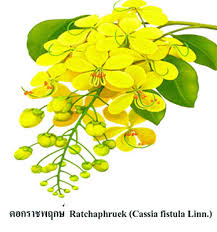
National Flower: “Ratchaphruek“ (or golden shower)
Ratchaphruek is chosen as national flower because it is widely known to Thais, which it can be plant and seen anywhere throughout the country. It bears beautiful cluster-shaped flowers in summer. The color of flowers is shining yellow contrasting great importance similarly to the color of our national religion ‘Buddhism’ and the color of Monday when His Majesty King of Thailand was born.


National Animal: “Chang Thai” (or Thai elephant)
Thai elephant is selected as national animal because it has maintained close link with Thai history and custom, it has a long life, and it is closely related to the livelihood of Thai people as one of transportation means both in times of peace and battles. Especially, ‘white elephant’ is deeply connected to King of Thailand, and white elephant was portrayed in the former national flag.

Thai tradition abounds with examples of the elephant playing an important role in the workings of the Kingdom. Most significant of all, perhaps, is the white elephant, prized because it is a rare animal judged fit only for royal duties.

According to ancient royal Thai traditions, a white elephant is a noble beast of special importance, exemplifying a king’s honor and glory. Known in Thai as Chang Samkhan, a white elephant is a gift fit for a king and to acquire one during his reign, will bring about prosperity and happiness throughout the kingdom.

Tourist visa in thailand

Any foreigners wishing to enter Thailand must obtain a visa from a Royal Thai Embassy or Royal Thai Consulate-General unless one wishes to stay in the Kingdom for 30 days for tourism purposes only. In this particular case, they are required to have a 30 day entry stamp and NOT a visa.

30 DAY ENTRY STAMP: is obtained free of charge at any port where you enter the Kingdom. There is no need for a visa and you can extend your stay up to 7-15 days in addition, depending on the immigration officer’s authorization. You must leave the kingdom upon the expiry. If you’re holding any kind of visa and getting this stamp, your visa is not relevant and will be valid until you re-enter the Kingdom (in which the stamp is “used”)

TOURIST VISA EXEMPTION
Some certain nationals are exempted from visa requirements due to Thailand’s bilateral agreements with the nations. Please note that this exemption applies ONLY to travelers with tourism purposes who stay in Thailand for 30 days. List of the exempted countries as following.

1. Australia: Commonwealth of Australia
2. Austria: Republic of Austria
3. Belgium: Kingdom of Belgium
4. Brazil: Federative Republic of Brazil
5. Bahrain: State of Bahrain
6. Brunei Darussalam: Negara Brunei Darussalam
7. Canada
8. Denmark: Kingdom of Denmark
9. Finland: Republic of Finland
10. France: French Republic
11. Germany: Federal Republic of Germany
12. Greece: Hellenic Republic
13. Hong Kong: Hong Kong Special Administrative Region
14. Iceland: Republic of Iceland
15. Indonesia: Republic of Indonesia
16. Ireland: Republic of Ireland
17. Israel: State of Israel
18. Italy: Republic of Italy
19. Japan
20. Korea: Republic of Korea
21. Kuwait: State of Kuwait
22. Luxembourg: Grand Duchy of Luxembourg
23. Malaysia
24. Monaco: Principality of Monaco
25. Netherlands: Kingdom of the Netherlands
26. New Zealand
27. Norway: Kingdom of Norway
28. Oman: Sultanate of Oman
29. Peru: Republic of Peru
30. Philippines: Republic of the Philippines
31. Portugal: Republic of Portugal
32. Qatar: State of Qatar
33. Singapore: Republic of Singapore
34. Spain: Kingdom of Spain
35. South Africa: Republic of South Africa
36. Sweden: Kingdom of Sweden
37. Switzerland: Swiss Confederation
38. Turkey: Republic of Turkey
39. United Arab Emirates
40. United Kingdom: United Kingdom of Great Britain and Northern Ireland
41. United States of America
42. Vietnam: Socialist Republic of Vietnam

VISA ON ARRIVAL
For tourists from certain countries (see below) who expect to stay less than 15 days, you can apply for a visa at certain immigration checkpoints upon your arrival in Thailand (see below). The applicant must possess at least 10,000 baht and a passport with at least six-month validity. A recent photograph (4X6 cm) is required in the application and the fee is 1000 baht. The duration of stay cannot be extended for this type of visa.
List of countries and territories is as follows:

1. Bhutan : Kingdom of Bhutan
2. China : People’s Republic of China
3. Cyprus : Republic of Cyprus
4. Czech : Czech Republic
5. Estonia : Republic of Estonia
6. Hungary : Republic of Hungary
7. India : Republic of India
8. Kazakhstan : Republic of Kazakhstan
9. Latvia : Republic of Latvia
10. Liechtenstein : Principality of Liechtenstein
11. Lithuania : Republic of Lithuania
12. Maldives : Republic of Maldives
13. Mauritius : Republic of Mauritius
14. Oman : Sultanate of Oman
15. Poland : Republic of Poland
16. Russian Federation
17. Saudi Arabia : Kingdom of Saudi Arabia
18. Slovakia : Slovak Republic
19. Slovenia : Republic of Slovenia
20. Taiwan
21. Ukraine

List of Thailand’s Immigration Checkpoints which provide facilities for issuance of visa on arrival:
1. Suvarnabhumi Airport
2. Don Muang International Airport , Bangkok
3. Chiangmai International Airport , Chiangmai
4. Phuket International Airport , Phuket
5. Hatyai International Airport , Songkhla
6. U Tapao Airport , Rayong
7. Mae Sai Immigration Checkpoint , Chiangrai
8. Chieng Saen Immigration Checkpoint , Chiangrai
9. Chieng Khong Immigration Checkpoint , Chiangrai
10. Betong Immigration Checkpoint , Yala
11. Sadoa Immigration Checkpoint , Songkhla
12. Samui Airport , Surat Thani
13. Sukhothai International Airport, Tak Immigration Checkpoint
14. Bangkok Harbour Immigration Checkpoint, Bangkok
15. Sri Racha Immigration Checkpoint , Chonburi
16. Mabtaput Immigration Checkpoint , Rayong
17. Nong Khai Immigration Checkpoint, Nong Khai
18. Samui Immigration Checkpoint , Surat Thani
19. Phuket Immigration Checkpoint , Phuket
20. Satun Immigration Checkpoint , Satun
21. Krabi Immigration Checkpoint , Krabi
22. Songkhla Harbour Immigraion Checkpoint , Songkhla
23. Chiangrai Airport Immigration Checkpoint, Chiangrai
24. Surat Thani Airport Immigration Checkpoint , Surat Thani

Other Types of Visa
If you wish to stay longer than one month or require multiple entries, you will be legally required to apply for a visa prior to your arrival in Thailand.

1. Three month validity, single entry tourist visa
A holder of this kind of visa is permitted to stay for 60 days in the Kingdom. This type of visa can be extended for another 30 days at an immigration office. This visa can be used only once and the holder is required to leave the country once it expires.
2. Six month validity, 2 to 4 entry tourist visa
This type of visa permits a tourist to stay in the Kingdom for 60 days. A holder can file an application for a 30-day extension of stay after which one must leave the country. The holder may return to Thailand and will be able to stay in Thailand for another 60 days. The holder may re-enter the Kingdom until the stipulated entries are used.
3. Three month validity, single entry non-immigrant visa
The holder of this kind of visa obtains a permission to stay in Thailand for 90 days and is able to extend his/her stay up to one year with additional documentation at an immigration office (see No.5). This visa can be used for one only entry and the holder must leave the Kingdom as soon as the visa expires
4. Twelve month validity, multi entry non-immigrant visa
This visa permits a holder to stay in Thailand for 90 days. Upon each entry, the holder of a valid visa of this type will obtain a further 90 days of permission to stay in the Kingdom. This visa can be issued for students, work, family etc. but additional documentation is required and can be extended up to one year for specific reasons with supporting documentation (see No.5). If you are married to a Thai citizen and can provide proper marriage certificate to some Royal Thai embassies, you may be qualified for a 12-month validity, multi entry non-immigrant visa.
5. Twelve month extension to a non-immigrant visa.
A holder of a non-immigrant visa may extend his/her visa up to12 months upon such requirements as retirement (50 years old or over) or support to Thai citizen, education or work. This can be obtained only at any immigration offices inside the Kingdom and certain requirements must be fulfilled. The extended visa will contain details of “issue date” and “permitted to stay until” date.

Notes

1. A holder of a non-immigrant visa with an extension who wishes to leave the Kingdom at any time will need to obtain a re-entry permit. Re-entry without a proper multi-entry permit will require you to re-apply your visa and subsequently the extension of stay.
2. A holder of a non-immigrant visa with an extension is legally required to report current address to an immigration office using the form TM. 47 every 90 days. Re-entering is considered equivalent to the report.
3. A holder of a valid tourist visa or a 30 day visa exempt who are plan to extend his/her stay may be permitted to a non-immigrant visa at an immigration office inside the Kingdom. The change of the status of your visa can be accomplished under certain restrictions and your circumstances. Therefore, it is important to ask an immigration officer beforehand.

Additional information regarding Thai visa issuance can be viewed on http://www.mfa.go.th/web/2482.php?id=2487.